Table Of Content
These guidelines use elements to tell a story or atmosphere and help blend the elements effectively. This is where certain elements guide the viewer's eye through a planned sequence of elements. Some authoring tools provide ready made ‘themes’ which have already been set up to adhere to the very best elearning and web design practices.
Visual Weight
You can notice an example of the correctly applied proximity principle in the following two wireframes (image below). In the image above, on the left, you can see an e-commerce page wireframe with thumbnails, titles, and everything else crammed together with no whitespace in between. It is challenging for the eye to discern which buttons relate to which thumbnail.
Unity
Also, our brains have a much easier time, allowing us not to waste additional energy on that unnecessary task. It, in turn, creates a feeling of more comfortable experience scanning and reading this website. Repeating specific elements in a design helps give your website a unified look and feel. For example, if you use the same font for all your headings, all your designs will feel connected, and users will start associating that font with your brand. For example, if you want to highlight a call-to-action button, you would use a color that contrasts sharply with the background color of your website. By using contrast, you can direct your users’ eyes to the most important elements on your page by creating emphasis and helping them understand your content better.
Proximity: Grouping Related Elements
Narrow columns and long words can pose readability issues when justification is used. It is the concept that advocates organizing information to create order. Contrast in shape can be as basic as adding round corners to your quadrilateral elements, or as extreme as using circular elements together with square ones.
With proximity, instead of putting the most important thing at the top, the most important thing will be the biggest thing. Proportion adds order and perspective, creating a relationship between elements. This picture cleverly uses negative space to outline the person's body.
Zero-In on the Best Designs With A/B Testing
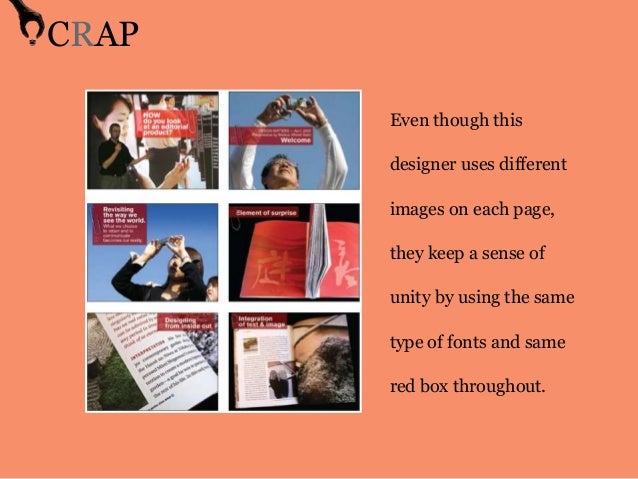
Different sections have the same ribbon graphics to contain their headings. Contrast is all about making sure that different elements on your page stand out from one another. Use contrast to create visual interest and highlight important information. According to statistics, 88% of people who shop online say they would not return to a website if they had a bad user experience. Furthermore, only 55% of companies test UX for business purposes. And in vain, because UX can not only increase traffic to your website but also your monthly income.
Shortfall of the tall: most skyscrapers 'are crap pieces of design', expert says - Domain News
Shortfall of the tall: most skyscrapers 'are crap pieces of design', expert says.
Posted: Mon, 16 Oct 2017 07:00:00 GMT [source]
Frequently Asked Questions About CRAP Design
It goes without saying that putting repetition (or consistency) to these website elements will help in improving the user experience. Alignment refers to where text and images are positioned on a page or window. Placing elements next to or near each other or in alignment suggests they are related.
Understanding the Importance of Design Principles
These principles are essential in creating visually appealing and intuitive designs that engage users. Contrast is one of the fundamental design principles used to distinguish between sections or elements of your asset. Nobody likes to navigate around a website with an entirely white background. Break those elements up a bit by adding complimentary background colors to the sections around it. Another way of adding contrast is to use large or bold text, also known as “headers.” Contrast can be overlooked or over applied easily.
It also involves alignment between separate objects, text blocks, and all other design elements. When used correctly, repetition can also help to emphasize certain elements and make a design more memorable. For example, some brand attributes in the form of color, shape, logo, or tagline can be repeated over and over again in the designs, even in different mediums. Remember, as long as there is a clear distinction between the various elements and you’re not sacrificing other CRAP design principles, then you are doing it right. Poor contrast can make it difficult for users to read text or click on links, and it can also cause problems for users with vision impairments.
When you align the text to the left and neatly organize all the sections to be in line with each other, our brains have less work to do. Your dedicated VWO representative, will be in touch shortly to set up a time for this demo. We will come prepared with a demo environment for this specific website. While both the cards above contain the same information, the way it’s presented is different.
In terms of elements, you can align them based on their edges or their centers. However, texts can be aligned to left, right, or center, or can simply be justified. This Instructable will demonstrate the CRAP design principles and teach you how to use them. Design principles are used to make your designs pop out and guide the audiences eye where you want it to go. The principles include contrast, balance, pattern, variety, and unity.
User experience designers create user interfaces that are easy to learn and navigate using this educational principle. In the same way, the body text of a web page is usually a color that contrasts with the background, making the text easy to read. Similarly, a great web page creates visual contrast with white space and carefully-planned color schemes.
Negative space is a big component in web and graphic design, creating a feeling of minimalism and simplicity. The four basic principles of design include simplicity, clarity, consistency, and accessibility. The R stands for “reduce,” while the P stands for “prioritize.” These two words are used to describe how to create a better design. Reducing clutter and prioritizing what matters most are key concepts when designing a new website. That way, you’ll only have to go through the design process the first time.
The principles behind C.R.A.P. design stem from commonly-accepted rules for the use of color, light, line, and layout. Every beautiful painting or photograph includes proper contrasting. Repetition and proximity organize nearly every document in existence. For designers, it's a way of getting audiences to focus on something. Contrast is the difference between elements where their combination makes some elements stand out from others. With the growing use of mobile devices for web browsing, proximity becomes even more critical.
This helps users identify each slide as a part of a bigger whole (or a brand). All together these design principles, commonly referred as CRAP or CARP, make all the great design you see today. Playbills and posters for movies and musicals use these principles. Graphic designers use these to create eye catching websites, logos and more.
Experiment to discover which one fits your design the most Also, do not forget other CRAP design principles. By paying attention to this principle, you can create designs that are pleasing to the eye and function well on a practical level. You can use it not only in the context of an individual design but also connect all your related designs. It is why of all CRAP design principles, this principle can be used most widely. This principle states that elements on a page should have enough contrast so that they are easily distinguishable from one another.




No comments:
Post a Comment